


- 1. What is BSc Accident and Emergency Care Technology?
- 1.1 BSc Accident and Emergency Care Technology Course Details
- 2. BSc Accident and Emergency Care Technology Course Details
- 3. The Roadmap: Accident and Emergency Care Technology Syllabus
- 4. Why Choose This Field in 2025?
- 4.1 BSc Accident and Emergency Care Technology Salary
- 5. Why Mahalakshmi College is Among the Best BSc Accident and Emergency Care Technology Colleges in Tamil Nadu
- 6. Conclusion: Are You Ready to Respond?
When every second counts, a well-trained professional is the difference between life and loss. In the rapidly evolving landscape of Indian healthcare, the demand for skilled first responders has never been higher. If you are looking for a career that combines adrenaline, medical expertise, and the profound satisfaction of saving lives, bsc accident and emergency care technology is your calling.
At Mahalakshmi College of Allied Health Sciences, we don't just teach medicine; we forge heroes. As one of the premier bsc accident and emergency care technology colleges in tamilnadu, we provide the rigorous training needed to handle high-pressure trauma and medical crises.
What is BSc Accident and Emergency Care Technology ?
A b sc accident and emergency care technology degree is a specialized undergraduate program designed to train students in the immediate and urgent treatment of acute illnesses and injuries. Unlike traditional nursing or general medicine, this course focuses on the "Golden Hour", the critical window immediately following a trauma or medical emergency.
BSc Accident and Emergency Care Technology Course Details
The program typically spans 3 years of academic study plus a 1-year mandatory internship. During this time, students are transformed into Emergency Medical Technologists (EMTs) capable of managing:
- Road traffic accidents and trauma care.
- Cardiac emergencies and strokes.
- Disaster response and mass casualty management.
- Pre-hospital stabilization in ambulances.
For a deeper look at the specific curriculum, visit our dedicated BSc Accident and Emergency Care Technology course page.
The Roadmap: Accident and Emergency Care Technology Syllabus
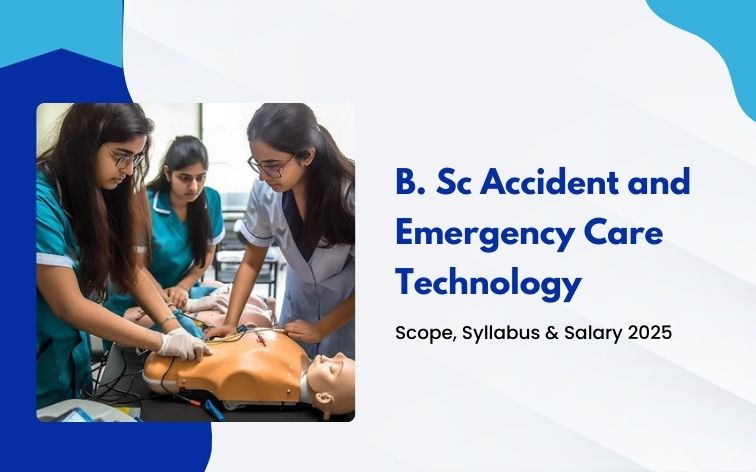
The accident and emergency care technology syllabus is meticulously crafted to ensure students are ready for the intensity of the Emergency Room (ER). At Mahalakshmi College, we emphasize hands-on learning alongside deep theoretical knowledge.
| Year | Key Subjects |
|---|---|
| First Year | Anatomy, Physiology, Biochemistry, and Basic Nursing. |
| Second Year | Applied Pathology, Microbiology, Pharmacology, and Introduction to Emergency Medicine. |
| Third Year | Trauma Management, Medical & Surgical Emergencies, Pediatric Emergencies, and Advanced Life Support (ALS). |
Students gain proficiency in operating complex medical equipment such as ventilators, defibrillators, and ECG machines. To understand how this translates into a long-term professional path, read our feature on BSc. Accident and Emergency Care Technology as a career.
Why Choose This Field in 2025?
Recent statistics highlight a significant growth in India's emergency medical services. In December 2025, states like Odisha launched over 400 new ambulances to bolster their healthcare infrastructure, signaling a nationwide push for better emergency response. The India Ambulance Services Market is currently valued at over $1.6 billion and is growing at a CAGR of 4.75%.
This expansion translates directly into job security and competitive pay.
BSc Accident and Emergency Care Technology Salary
The bsc accident and emergency care technology salary in India is promising for graduates.
- Freshers: Can expect to start between ₹2.5 Lakhs to ₹4 Lakhs per annum.
- Experienced Professionals (3-5 years): Salaries often climb to ₹5 Lakhs – ₹8 Lakhs, especially in metropolitan trauma centers or private multi-specialty hospitals like Apollo or Fortis.
Why Mahalakshmi College is Among the Best BSc Accident and Emergency Care Technology Colleges in Tamil Nadu
Choosing the right institution is the first step toward excellence. Here is why Mahalakshmi College stands out:
- Clinical Exposure: We have tie-ups with leading hospitals, ensuring our students spend significant hours in real ER settings.
- Advanced Simulation Labs: Practice life-saving procedures in a risk-free environment before stepping into the field.
- Expert Faculty: Learn from doctors and senior paramedics who have years of experience on the frontlines.
- Placement Support: Our dedicated cell helps students land roles in trauma centers, government 108 services, and international healthcare chains.
Conclusion: Are You Ready to Respond?
The world needs more people who can keep their cool when others panic. By choosing bsc accident and emergency care technology, you aren't just getting a degree; you are gaining the power to change outcomes in life-or-death situations.
Ready to take the leap? Explore our Home Page for more information or visit our Contact Page to speak with an admissions counselor today.
Frequently Asked Questions (FAQs)
To enroll in bsc accident and emergency care technology, candidates must have completed 10+2 with Physics, Chemistry, and Biology (PCB) with a minimum of 50% aggregate marks.
Yes, it is a highly rewarding career. Given the rising number of hospitals and specialized trauma centers, graduates of b sc accident and emergency care technology are in high demand across India and abroad.
A fresher can expect a bsc accident and emergency care technology salary ranging from ₹18,000 to ₹30,000 per month, depending on the hospital and city.
Mahalakshmi College of Allied Health Sciences is among the leading bsc accident and emergency care technology colleges in tamilnadu, known for its excellent infrastructure and clinical training.
Absolutely. Emergency care technologists are in high demand in the Middle East, UK, and Canada. You may need to clear specific licensing exams (like DHA or MOH) to practice in those regions.
The accident and emergency care technology syllabus includes Anatomy, Trauma Management, Pharmacology, Advanced Life Support, and Disaster Management.
The course is typically a 4-year program, consisting of 3 years of classroom and lab training followed by a 1-year clinical internship.
Graduates can work as Emergency Medical Technicians (EMTs), Trauma Care Assistants, ER Technicians, or Disaster Management Specialists in both government and private sectors.